

Nigeria! What Next? Road to Greatness.
Nigeria will elect a new president in the next few months; what do we need? Do we go with Obi, a young and vibrant president who looks inexperienced? Do we go with experience in Atiku or Tinubu?

Nigeria will elect a new president in the next few months; what do we need? Do we go with Obi, a young and vibrant president who looks inexperienced? Do we go with experience in Atiku or Tinubu? I will do my best to break things down based on my study of Nigeria since the military regime in the 1990s.
We have seen so many leaders in Nigeria battle to deliver good governance. We sit behind and think about how easy it is to run a federal government as big as Nigeria. Growing up, I always felt it was easy for a president to rule a country as big as Nigeria. I never even knew what a constitution was, never knew Nigeria was guided by specific laws that hindered her progress. How could our founding fathers or the drafters of the 1999 constitution not even think about our progress, peace, and unity? How could one government be so powerful, leaving out the essential 36 components of what makes Nigeria actually Nigeria? While I took government and economics classes in secondary school, I interacted with my teachers beyond what they taught; why was Nigeria regarded as a banana republic? My teacher, whom we nicknamed MOG (Man of God), will always tell me Nigeria was indeed a banana republic. A place where the military did whatever they liked, deceived the citizens, and subjected them to excruciating suffering. He told me of Saro-Wiwa, who died alongside nine others for a crime they did not commit. I could feel the passion and chauvinism in his voice. And even as I read his book years later, I could feel the deep sense of a patriotic Nigerian who wanted a better country. I grew up with so many questions. I loved Nigeria. Why couldn’t we get it right in this part of the world? Why could the most prominent black nation not fix itself and reign as the most prosperous black nation competing well with world powers like the US and China?
Democracy came in 1999, just at the beginning of my secondary education.
My interest in politics grew after I read Mr. Ogbor’s book. I decided to follow with a keen interest in particular political leaders. Obasanjo, Yaradua, the father of the former president Yaradua, Atiku, Donald Duke, Pius Ayim, Bola Tinubu and so many others. One person I fell in love with was Atiku Abubakar. For my persona, he appealed to everything I felt about what politics should be; equity, understanding, peace, fairness, progress, and justice. Choosing a president for me is not about who is the most saintly. I have never decided who I vote for based on the corruption index or measurement of how clean the person is. Going into the 2019 Elections, I was excited to see Atiku and Peter join hands to rescue Nigeria, a mix of experience, youth, dynamism, and forward-thinking individuals. The outcome of 2019 was a disappointment, and I looked forward to 2023, hoping the same ticket would fly under the PDP. Here we are with a divided opposition to the worst party to rule Nigeria.
The task ahead is one that I still stand by my principles of electing a leader that can unite us and provide the foundation for an economic boom. Such a leader is Atiku Abubakar, and I’m casting my vote for him.
Nigeria Needs Healing
I have always felt that Nigeria never moved on from the civil war, we never healed from it, and we have held onto the hate for too long. My love for Nigeria made me return back after schooling in the UK. That love is almost lost. We need a fresh start to everything in Nigeria. Nigeria needs to tender apologies for the destruction caused, and the livelihood ended for most families. The states that suffered the civil war most should be compensated. Apologies are not enough; each state should receive a certain amount of money and compensation. For me, the best person to do this is a leader of Northern extraction, not one from the same place as the states in question. You may disagree with me, but Buhari had a unique opportunity to do this. He did not do it, and Nigeria experienced nepotism at its worst. This is what I believe Atiku can begin his presidency with. I love how he loves peace; tracking his decision-making from the early 90s, I realised he is a man of peace who loves to see things from other people’s perspectives. Dear Atiku, if you ever get to see my write-up, Nigeria must heal from the civil war. Do this for future generations.
Restart All States in Nigeria as Startups!
Whoever wins in 2023 needs to restart Nigeria. Treat all 36 states as startup businesses that must work. Creating 36 economic powerhouses is much better than making one leading economy. The president would have to be the founder of this startup and pitch for massive funding. Each state receives startup capital to begin functioning as a single economic unit. The LGAs must not be left out; they should be treated as the first point for generating economic activities and fostering economic growth. The startup face can be 2–5 years when states must aggressively pursue economic advancement. I see Nigeria generating 10–25m jobs if this is handled properly. Within this same period, the federal government cannot give monthly allocations. Still, it must focus on financing the military, paramilitary, revenue generation, and fiscal policies. The states must also treat the system as a business, not a government structure requiring hiring many civil servants to function. For example, suppose states are asked to generate power. In that case, they must do so via private sector-driven initiatives with investments from banks and foreign companies. States must encourage the private sector to run critical processes and focus on industrialization, production, and competition must be enabled.
True Federalism
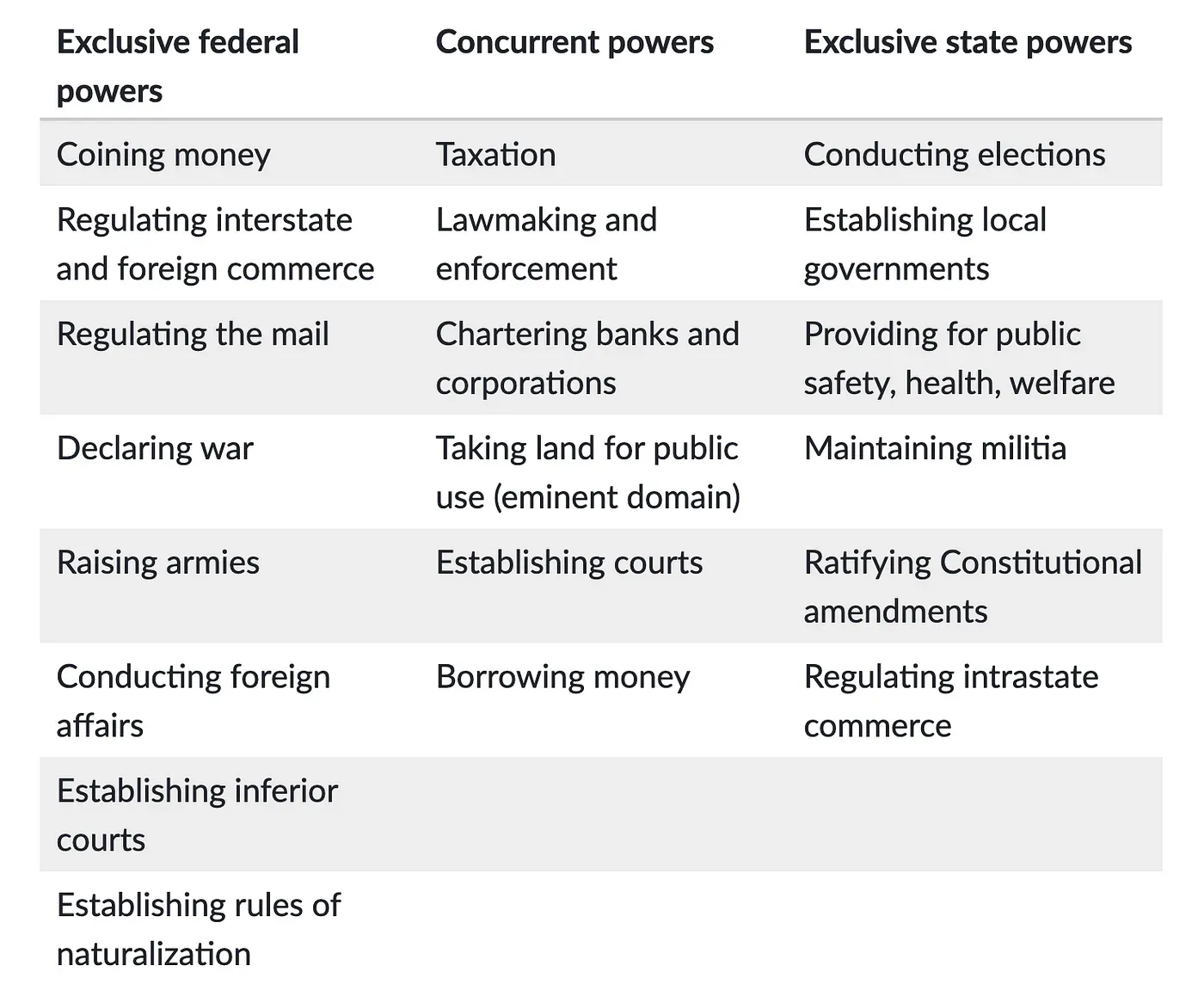
True federalism is a system of shared governance between national and state governments. Both governments have exclusive and concurrent powers, which help to explain the negotiation over the balance of power between them. Finally, in this system, The federal government can encourage the adoption of policies at the state level through federal aid programs. In the United States, the federalist system emerged because the states evolved from separate colonies with diverse populations and different needs. The Framers of their Constitution envisioned that state governments, not the national government, would be citizens’ primary government units daily. Nigeria must adopt a system that respects the diversity that makes up Nigeria. When the states are given enough control of their jurisdictions to administer laws made by the state assemblies in their entirety, Nigeria will move forward and progress rapidly without ambiguity.
The NIMCE database should be open so that all registrations within a state are administered and controlled only by the state’s authority. Things like marriage licenses and terms for divorce should all be within the purview of the local and state governments. Others like driver’s licenses and car registrations should all be within the local and state governments’ authority. Only a state can approve the generation of a NIN. No other third party can approve such except a state grants express access to such a third party. This move by the FG will ensure participation and inclusion in the administration of the national database and create a sense of ownership by all 36 federating states.
Yes, we all want the states to control revenue generation and management. Revenue sharing and management will be a critical deciding factor in how the new federal system will work. I propose a framework allowing states and FG to share accrued revenue in a ratio as decided by FG and all federating states. Such a framework will enable automatic sharing to happen when payments come in. The old system where FG receives all revenue and then shares for the state every month would not work in a setup as such. Instead, the framework will allow states and FG to receive value in real time when transactions are made. Naturally, states should keep a more significant chunk of the generated revenue (70–75%) while the FG keeps less (25–30%). For equity and participation in this new system, generated revenue will also have to be shared based on originating LGA. LGAs will have to also be included in the sharing.
In a proper federal system, only the federal government can print money, plan fiscal policies, declare war, manage immigration or conduct foreign affairs. These powers make a lot of sense handling them from the center. The federal government’s exclusive powers help the nation operate as a unified whole. The states, on the other hand, would have to retain a lot of control over the new structure, however. The new federal system should also allow them to conduct all, even presidential elections, and must ratify constitutional amendments. They can make policies to cover commerce, taxation, healthcare, education, and many more areas within their jurisdiction. So long as their laws do not contradict national laws.
States must also control policing. The federal government has no business running a police system that covers all 36 states. Let us consider that the youngest state in Nigeria was created in 1996; such a state is already 26 years old. The federal government must realise that these states can now manage their entire administration without interference. An effective policing system built around states will ensure the availability of human resources and effective management of community policing. No doubt that our current system of policing is no longer an option. The officers born from this current system see the citizens as enemies, not people they should protect. Federal law enforcement will work in collaboration with the state police. A binding law should mandate state police departments to share information with the federal government. Such information should also be shared with neighboring states to combat interstate crimes.
Education
Education in Nigeria is overseen by the ministry of education. At first glance, one would expect this involvement only at policy levels. This is not the case, as the federal government is heavily involved with secondary and tertiary education. According to statistics, in 2019, some 73.4 thousand academic employees worked at universities in Nigeria, including professors, readers, and lecturers. Federal universities employed the highest number of academic staff. They counted seven thousand professors, 3.4 thousand readers, and 29 thousand senior lecturers, lecturers, and below. This data covers only universities. We also have colleges of education, polytechnics, and other institutions set up by the federal government. Just a look at the actual data shows the federal government could be burning down a lot of its revenue to keep such a staff strength. At the same time, subsidising education at the tertiary level.
How economical is this? How realistic is such a structure? Education cannot get to the best in Nigeria if this model is sustained. My candidate has proposed to hand over institutions to the states that house them. Is this a good plan? Will it work? Can education in Nigeria meet standards in primes where we all go for studies? I’m optimistic that this move will solve the educational challenges in Nigeria. This will come at a considerable cost, but it is the best solution. Atiku took a deliberate stand in aspects of his plan, and he has not been equivocal at any point. He is unequivocal on the education stand, but here are my thoughts on the way forward for tertiary education. When tertiary institutions are handed over to states, I do not think the FG transfers a burden or responsibility. Instead, I see a clear path for the states to take advantage of and build quality educational systems. I would be happy to see a state government that takes over such institution; invite local and international companies to bid for the complete takeover of these schools. The company with the best investment plans, quality assurance, and management approaches should win and take control of such institutions. The states may retain equity by keeping some ownership and having considerable board representation. I give such a university or tertiary institution just 2 years to become the best across the country.
I do not know how we got to a point where we yank over 1.2m students to write exams that expire, then use a quota system to give them admissions
This approach would create considerable competition amongst schools and even states. I want to see a Nigeria where the top universities pitch to convince top-quality talent. Let’s make an open competition for students to pick the best states. My choice of school would rely on certain factors; quality of the university, location, security, serene environment, quality lecturers, quality amenities, and so many other factors. Tertiary education is not for everyone, as I believe secondary education is enough to advance several career paths. I do not know how we got to a point where we yank over 1.2m students to write exams that expire, then use a quota system to give them admissions. Nigeria would not grow with such a system; competition improves a country. I rather have states battling it out to have the best Universities, colleges of education, and polytechnics.
Quality is expensive, but we should choose it way above what we have now.
Quality is expensive, but we should choose it way above what we have now. The educational policy of the federal government could channel consideration investments to universities annually to mitigate the operational cost. When the quality of education improves, the price will also go up for students and parents. This is when we can ask the federal government to intervene. This cost could become a subsidy for Nigerian students. The grants issued to tertiary institutions may constitute 25–30% of their annual running cost; as a result, Nigerian students would be able to get a 25–30% school fees subsidy. I also believe that several companies, banks, and organisations would come up with alternative funding methods for students.
Conclusion
Several other policies would be needed on this journey. Sectors like Agriculture, technology, mining, fashion, etc., would all pick up with the proposed structure. The petroleum sector is already on a recovery trajectory, and I don’t see us importing fuel in the next 3–5 years. I trust Atiku to consolidate on this sector as it holds the key to making Nigeria a true giant and also strengthening our Naira.
This write-up is not focused on selling my candidate, as I respect the choices of everyone. All of us cannot support one person, and this is okay and called a democracy. I choose my candidate because of the belief and trust that I have seen over the years. I believe he deserves a chance to run Nigeria haven run several businesses to significant success using his established blueprint. I already know he is corrupt from his past. I have studied leadership over the years and patterns; I realised corruption is not a factor even in climes, where we all emigrate for greener pastures. They practice systemic corruption and this almost makes it official.


